

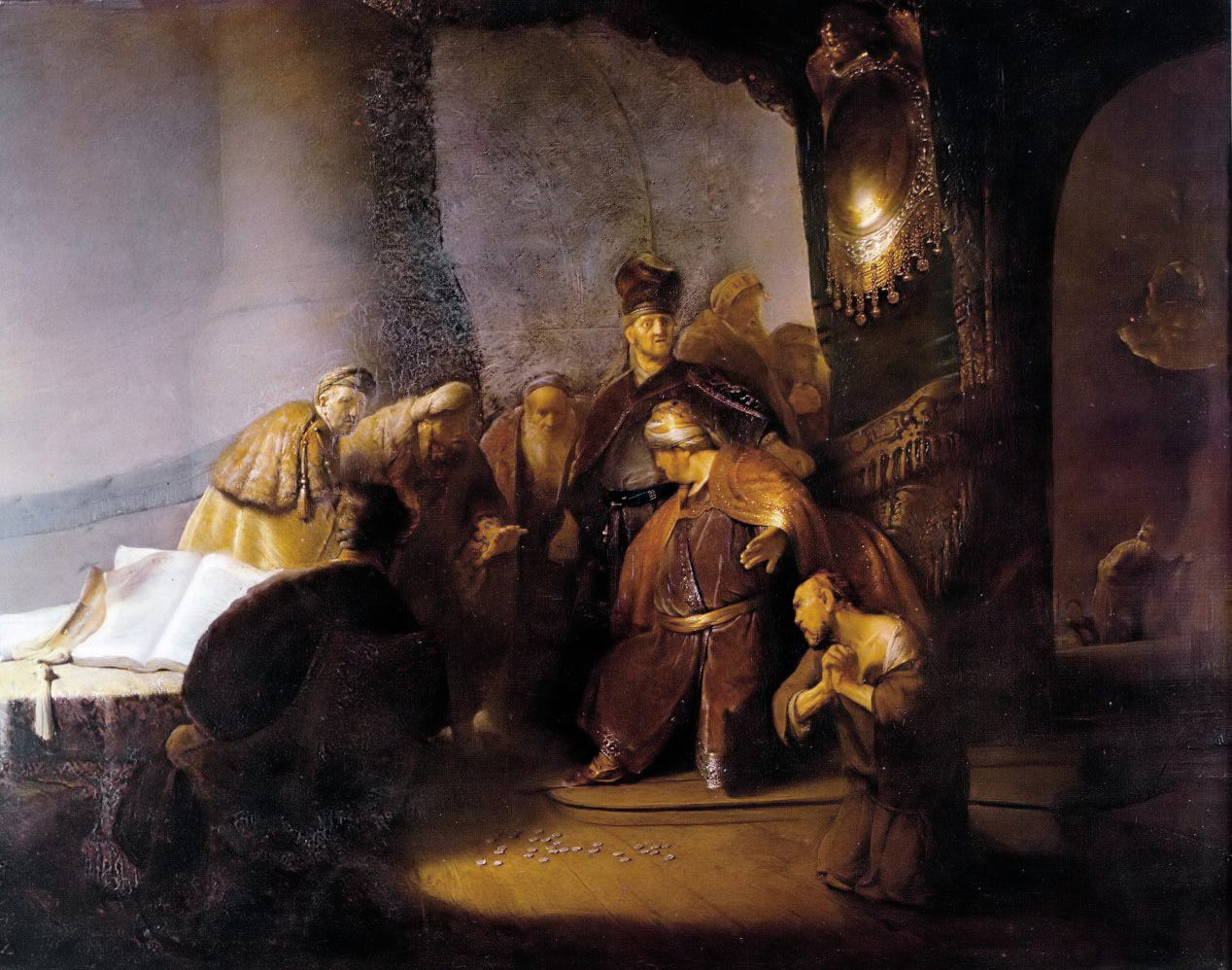
Friday evening I attended a performance of Bach’s St. Matthew Passion at the Baltimore cathedral.
I was especially taken by the aria that follows Judas’ returning of his bounty. After the betrayer has thrown the thirty pieces of silver at the feet of the high priest and gone out to hang himself, the bass-baritone sings:
Give back this my Jesus to me!
See the price, this murderer’s wage,
thrown by this the fallen son
at your feet before you!
Now that the blood money has been returned, the soul pleads for the one whom it purchased to be returned as well. Give back my Jesus.
It is worth our reflection, entering Holy Week and walking with Christ again to the cross, to consider ourselves in relation to Judas, the betrayer.
We are, with him, the fallen son or daughter who, time and again, sells our Lord for some price. Some benefit. Some gain. Some pleasure. Some advantage. And, some time there after, we hold the bag of silver in our hands, look at it, and realize: I don’t want this. This isn’t what I thought it would be. I have traded poorly. I gave up life and got death. Take this from me. Give back my Jesus.
Judas himself does not plead for Jesus’ return. He gives back the money; and he takes his life because of what he could not give away—his guilt and his shame. Though we can feel like Judas, we can—and must—do otherwise.
We watch Jesus go to the cross while we clutch the money bag in our pocket. We know it was for this betrayal—our betrayal—that he suffers and dies. We will watch his body be taken down and laid in the tomb, and we will feel that his body should be ours. We will see the stone which no man could move separate us from him: life from death and death from life.
These are not pleasant sights, dear friends, nor do they arouse pleasant feelings. Yet it is necessary that we think and feel them, if this week and the events commemorated therein have any meaning and leave any effect on us.
We cannot negate the fact of our betrayal. We cannot destroy the evidence. We cannot erase the memory. We cannot give back what we gained. We carry the money bag with us.
To run away, to look for quick relief, or to try somehow to undo our actions—all of this will only leave us frustrated. We will live only in death.
But to stay with Jesus, to walk with him the whole way, to carry the weight of our sins while he carries the weight of the cross, to stay at the tomb, to stare at the faceless stone, silver in hand, and plead, Give back my Jesus—this is the only way to life.
For at our pleading—the Church’s pleading—the stone will move. The tomb will be emptied. The cross will be exalted. The weight will be lifted. And our Jesus, whom we sold, will come to us, stand in our midst, show us his wounds, and take the money bag from our hands, speaking the words we long to hear: Peace be with you.
March 29, 2026, Chapel of the Immaculate Conception, Mount St. Mary’s University